Ration Card Online Apply – Eligibility, Documents & Complete Process
A Ration Card is an important household document in India that can help eligible families receive food grains and other benefits through the Public Distribution System (PDS). It is particularly important for households covered under the National Food Security Act (NFSA).
Today, many states allow citizens to start the Ration Card online application process through their respective Food and Civil Supplies Department portals. Depending on your state, you may be able to submit a new application, add family members, update details, check application status and download an electronic ration card online.
However, there is no single eligibility rule or application form that applies identically across India. The NFSA portal clearly states that identification of beneficiaries and issuance of Antyodaya Anna Yojana (AAY) and Priority Household (PHH) ration cards are handled by the respective State Governments and Union Territory Administrations.
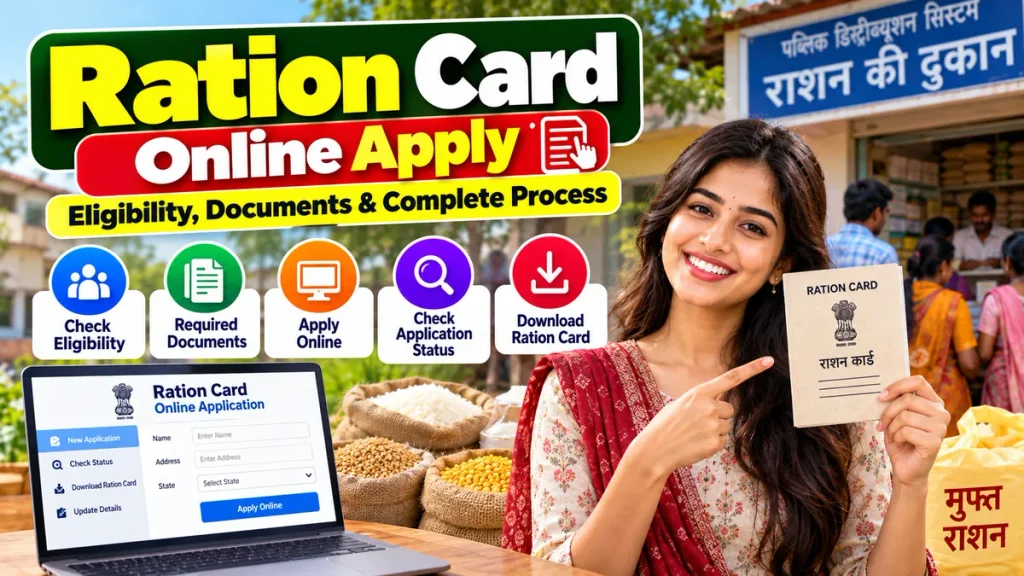
If you want to apply for a new ration card, this guide explains the eligibility criteria, required documents, online application process, verification and status-check procedure.
Ration Card Online Application at a Glance
| Particular | Details |
|---|---|
| Service | New Ration Card Application |
| Main System | State/UT Food & Civil Supplies Department |
| NFSA Categories | Priority Household and Antyodaya Anna Yojana |
| Application Mode | Online or offline, depending on state |
| Main Requirement | Applicant must satisfy state-specific eligibility criteria |
| Common Documents | Aadhaar, address proof, family details and supporting documents |
| Aadhaar/eKYC | May be required for verification |
| Application Status | Available online in many states |
| Food Grain Distribution | Through Fair Price Shops |
| Portability | Available to eligible NFSA beneficiaries through ONORC |
| Final Approval | Subject to verification by competent state authority |
What Is a Ration Card?
A ration card is issued by the relevant State or Union Territory authority to eligible households. It can be used to identify beneficiaries under the Targeted Public Distribution System.
Under NFSA, two important beneficiary categories are:
Priority Household (PHH): Eligible households identified according to criteria determined by the state or Union Territory.
Antyodaya Anna Yojana (AAY): Intended for eligible households among the most economically vulnerable sections.
The exact names of additional state-specific ration-card categories may vary.
It is important to understand that the Central Government does not directly decide every individual ration-card application. State and UT governments identify eligible beneficiaries and issue ration cards according to their applicable criteria.
Who Is Eligible to Apply for a Ration Card?
Ration-card eligibility differs from one state to another.
Generally, a household applying for a new ration card should normally reside in the state where the application is being made and satisfy the applicable inclusion and exclusion criteria.
An applicant usually should not already hold another active ration card in a different household or state unless the old record has been surrendered, transferred or otherwise dealt with under the applicable rules.
For example, West Bengal’s rules state that a citizen normally residing in the state who does not hold a ration card anywhere in India and satisfies the state’s eligibility criteria may apply for a new ration card. The application can be submitted online or offline and is subject to verification.
Because state rules differ, applicants should always check their own Food Department’s latest eligibility conditions before submitting the form.
Documents Required for Ration Card Application
The documents required for Ration Card Online Apply can differ by state and application type.
Commonly requested documents may include:
- Aadhaar Card of eligible family members
- Proof of residence or address
- Mobile number
- Passport-size photograph, where required
- Details of the head of household
- Names and dates of birth of family members
- Existing or surrendered ration-card details, if applicable
- Birth certificate for adding a child, where required
- Marriage-related documents when adding a spouse, where applicable
- Income or category documents where required by the state
Some states may ask for additional declarations or proof supporting eligibility.
For example, West Bengal’s current common ration-card application form asks for information including mobile number, date of birth, Aadhaar details, relationship with the head of family and other household details.
Before uploading documents, ensure that names, dates of birth and other information are consistent across your records.
How to Apply for a Ration Card Online
The online process varies by state, but the general steps are similar.
Step 1: Visit the Official NFSA Portal
Go to the official NFSA website and open the section for applying for a ration card.
The national portal directs applicants to the appropriate State or UT Food Portal, because new ration cards are issued by the respective state authorities.
Step 2: Select Your State
Choose the state or Union Territory where your family normally resides.
You will be redirected to the relevant state ration-card or Food Department service.
Step 3: Choose New Ration Card Application
Look for an option such as:
Apply for New Ration Card
New Family Registration
or
Ration Card Services
The exact wording varies by state.
Step 4: Register or Login
Enter the required mobile number, Aadhaar details or other information requested by your state’s portal.
Complete OTP authentication where applicable.
Step 5: Fill in Family Details
Provide accurate information about the head of household and all family members who should be included.
You may need to enter:
- Name
- Gender
- Date of birth
- Aadhaar number
- Relationship with head of family
- Address
- Mobile number
Step 6: Upload Documents
Upload the requested documents in the required format.
Make sure scans or photographs are clear and readable.
Step 7: Submit the Application
Review all details carefully before final submission.
After submitting, save your application/reference number because it may be required for tracking your application.
What Happens After You Apply?
Submission of the online form does not automatically mean that a ration card will be issued.
The responsible authority may verify your household information, documents and eligibility.
Some states may conduct physical verification where required.
For example, West Bengal’s rules allow the ration-card issuing authority to investigate eligibility and, for a new household, conduct enquiries involving the household or neighbourhood.
If the information is found correct and the household satisfies the applicable rules, the application may be approved.
How to Check Ration Card Application Status
Most state Food Department portals provide an application-status facility.
Usually you need information such as:
- Application number
- Registered mobile number
- Ration-card number, if already generated
- Date of birth or other verification information
The NFSA platform also provides facilities for checking certain Common Registration Facility applications using the state, CRF reference number and date of birth of the head of family.
Your state’s own portal may use a different tracking system.
Can You Download an e-Ration Card?
Many states provide digital ration-card facilities.
Once your application is approved and a ration-card number is generated, your state portal may allow you to download an electronic ration card.
For example, the West Bengal Food & Supplies portal provides a dedicated e-Ration Card facility and online services for new cards, adding family members, checking application status and linking Aadhaar/mobile numbers.
Availability and download procedures differ by state.
What Is One Nation One Ration Card?
The One Nation One Ration Card (ONORC) system allows eligible NFSA beneficiaries to access their entitled food grains using their existing ration card at enabled Fair Price Shops across India.
The Department of Food and Public Distribution states that portability is available nationwide and covers around 80 crore NFSA beneficiaries. Beneficiaries can use their existing ration-card details or Aadhaar authentication at an ePoS-enabled Fair Price Shop.
This facility is particularly helpful for migrant workers and families who temporarily live outside their home state.
Importantly, an existing NFSA beneficiary does not need to obtain a new ration card simply to use ONORC portability.
Common Reasons for Ration Card Application Delay
An application can be delayed or rejected for several reasons.
Common issues include:
- Incorrect Aadhaar details
- Duplicate ration-card records
- Wrong address
- Missing documents
- Family details not matching supporting records
- Applicant not meeting state eligibility criteria
- Existing ration card not properly surrendered or updated
- Failed household verification
- Unclear uploaded documents
Checking every detail before submission can reduce the risk of unnecessary delays.
Important Tips Before Applying
Always apply through an official government portal.
Do not pay an unknown agent who promises guaranteed approval.
Eligibility is decided according to government rules and verification, not by private agents.
Also avoid submitting multiple new applications for the same household. If you already have an application number, check its status first.
Frequently Asked Questions
1. Can I apply for a ration card online?
Yes. Many states and Union Territories provide online ration-card services. The NFSA portal directs applicants to their respective State or UT Food Department portals.
2. Is ration-card eligibility the same across India?
No. States and UTs identify eligible households and issue NFSA ration cards according to applicable criteria.
3. Which documents are required for a new ration card?
Common documents include Aadhaar, address details, mobile number and information about household members. Additional documents vary by state.
4. Can I have two ration cards?
A person should not normally be included improperly in multiple active household ration-card records. Duplicate records may be identified during verification.
5. How can I check my ration-card application status?
Use your state’s Food Department portal and enter the requested application or reference details.
6. Can I add a new family member online?
Many states provide services for adding eligible family members. The exact procedure and documents depend on the state.
7. Do I need a new ration card when moving temporarily to another state?
Eligible NFSA beneficiaries using One Nation One Ration Card generally do not need a new card simply to access portability benefits in another state.
8. Can I download a digital ration card?
Many states provide electronic ration-card facilities after approval. Check your state’s official Food Department portal for availability.
Conclusion
The Ration Card online application process has made it easier for eligible households to apply for food-security benefits without relying entirely on offline visits.
However, ration-card eligibility, documents and application procedures are controlled mainly by individual State Governments and Union Territory Administrations, so the exact rules can differ depending on where you live.
Before applying, check your state’s official eligibility criteria and keep your Aadhaar details, address information, family-member records and supporting documents ready. Complete the application carefully, save the reference number and regularly check your status until verification is complete.
Once approved, eligible NFSA beneficiaries may receive their applicable food-grain entitlement through Fair Price Shops and can also benefit from nationwide portability through the One Nation One Ration Card system.
For the safest application process, always use the official NFSA or your State Food Department portal and verify all information before submitting your form.