Unknown Number Calling You? How to Check If It Is Spam or Fraud
Receiving a call from an unknown number can create instant curiosity. It could be a delivery agent, bank, business, recruiter, or someone you know using a different phone. But unknown numbers are also commonly used for spam calls, phishing attempts, fake customer-care calls, financial scams, and impersonation fraud.
Instead of immediately answering or calling back, you can use caller identification tools and a few simple checks to determine whether an unknown number may be legitimate, spam, or potentially fraudulent.
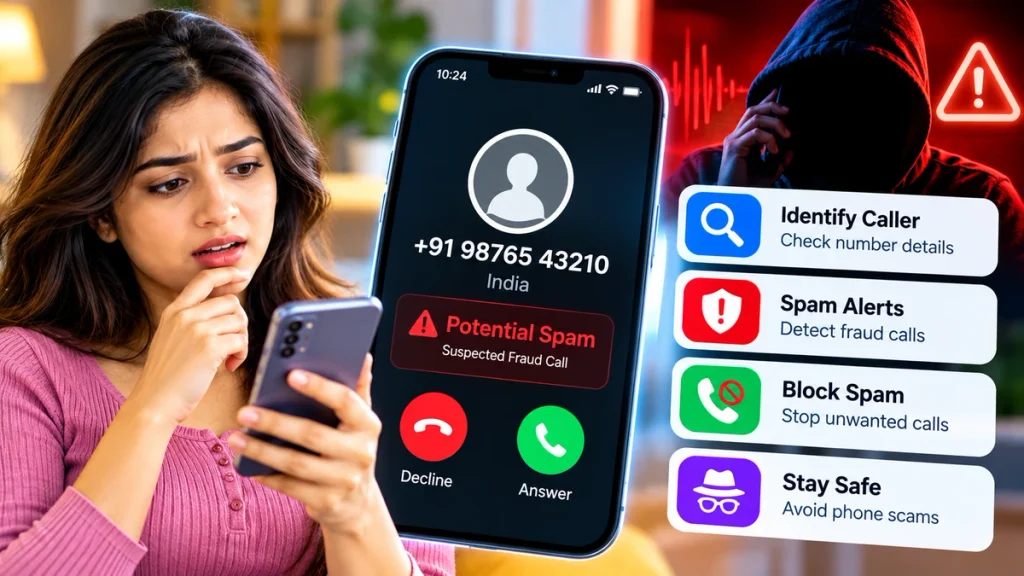
How to Check an Unknown Number
| Method | What It Can Tell You | Best For |
|---|---|---|
| Built-in Caller ID | Business name or spam warning | Quick identification |
| Caller ID App | Name, spam reports, category | Unknown callers |
| Reverse Number Lookup | Available information about number | Additional verification |
| Search Engine | Business reports or complaints | Suspicious numbers |
| Spam Blocking | Detects and filters known spam | Frequent unwanted calls |
| Official Reporting | Reports suspected fraud | Serious scam attempts |
1. Check Your Phone’s Built-In Caller ID
Many Android phones using the Phone by Google app can automatically display information about businesses or callers outside your contacts.
Google’s caller ID and spam protection can also warn you when a number is considered potential spam. Users can enable spam filtering and report unwanted callers directly from the Phone app.
Look for labels such as:
- Spam
- Suspected spam caller
- Business name
- Possibly fake number
- Unknown caller
However, a caller ID label should be treated as an indicator rather than absolute proof.
2. Use a Caller ID or Spam Detection App
Caller identification apps such as Truecaller can help identify unknown phone numbers and show whether other users have reported a number for spam, fraud, robocalls, or telemarketing.
Truecaller also provides spam blocking and allows users to create block lists. Its spam information is partly based on community reports.
This can be particularly useful if the same unknown number calls repeatedly.
3. Search the Number Online
Another easy method is to enter the complete phone number into a search engine.
You may find:
- Business listings
- Customer-care information
- Spam complaints
- Scam warnings
- Forum discussions
- Publicly listed contact details
If someone claims to represent a bank, insurance company, telecom provider, or other organization, don’t rely only on information supplied by the caller.
Instead, visit the organization’s official website or app and contact the company using its published customer-care number.
4. Watch for Common Fraud Warning Signs
A suspicious caller may try to create panic or urgency.
Be cautious if someone says:
- Your bank account will be blocked immediately.
- Your SIM card will be disconnected.
- Your KYC needs urgent verification.
- Police have issued a case against you.
- You have won a lottery or prize.
- You must pay a fee to receive money.
- Your electricity connection will be disconnected.
- You need to share an OTP to verify your account.
India’s Department of Telecommunications has warned about fraudulent calls impersonating authorities and threatening users with mobile-number disconnection or legal consequences.
5. Never Share OTP, PIN or Banking Details
A genuine incoming call should not require you to reveal sensitive authentication details.
Never give an unknown caller your:
- OTP
- UPI PIN
- ATM PIN
- CVV
- Internet banking password
- Card password
- Aadhaar-related authentication details
- Remote access to your phone
If someone claims to be calling from your bank, disconnect the call and contact your bank through its official number.
Can Fraudsters Fake Caller ID?
Yes. Caller ID information can sometimes be spoofed, meaning criminals manipulate the displayed calling number so the call appears to originate from another number.
The Department of Telecommunications has specifically warned about international fraud calls being disguised as Indian mobile numbers.
This means even a familiar-looking number should not automatically be trusted when the caller asks for money or sensitive information.
What Should You Do With a Suspicious Number?
If a number appears suspicious:
- Do not provide personal or financial information.
- End the call if the caller pressures or threatens you.
- Search or verify the number independently.
- Block the number if necessary.
- Mark it as spam in your Phone or caller ID app.
- Report serious suspected fraud through an official channel.
In India, suspected fraudulent calls, SMS messages, and WhatsApp communications can be reported through the Chakshu facility on Sanchar Saathi.
If you have already lost money or become a victim of cyber fraud, the DoT advises reporting the matter through India’s cybercrime system or helpline 1930.
Frequently Asked Questions
Can I find the name of an unknown caller?
Sometimes. Built-in caller ID services, reverse lookup services, and caller identification apps may provide a name or business identity when information is available.
Does a spam warning mean the call is definitely fraudulent?
No. Spam identification systems can make mistakes. Treat the warning as useful information and verify important calls independently.
Should I call an unknown number back?
Avoid immediately returning suspicious international, premium-rate, or repeatedly missed calls. Verify the number first when possible.
Can I block spam calls automatically?
Yes. Phone by Google provides spam filtering on supported devices, while caller ID apps such as Truecaller offer additional blocking features.
Conclusion
An unknown call does not automatically mean fraud, but it is worth checking before sharing information or taking action.
Use caller ID, spam detection, reverse number lookup, online searches, and official verification channels to investigate suspicious numbers. Most importantly, never allow urgency, threats, or attractive offers to pressure you into revealing passwords, OTPs, banking information, or sending money.
A few seconds spent verifying an unknown caller can help protect your privacy, phone, and finances.