How to Apply for Driving Licence – Documents, Fees, Test & Approval Process
Getting a Driving Licence in India is necessary if you want to legally drive a motorcycle, car or another motor vehicle on public roads. The process may look complicated for a first-time applicant, but most of the application procedure can now be started online through the government’s Sarathi Parivahan portal.
A new applicant normally starts by obtaining a Learner’s Licence (LL). After holding a valid Learner’s Licence for at least 30 days, the applicant can apply for a permanent Driving Licence and appear for the practical driving test.
The process includes checking eligibility, submitting documents, paying the prescribed fees, obtaining the Learner’s Licence, booking a driving-test slot and passing the test conducted by the licensing authority.
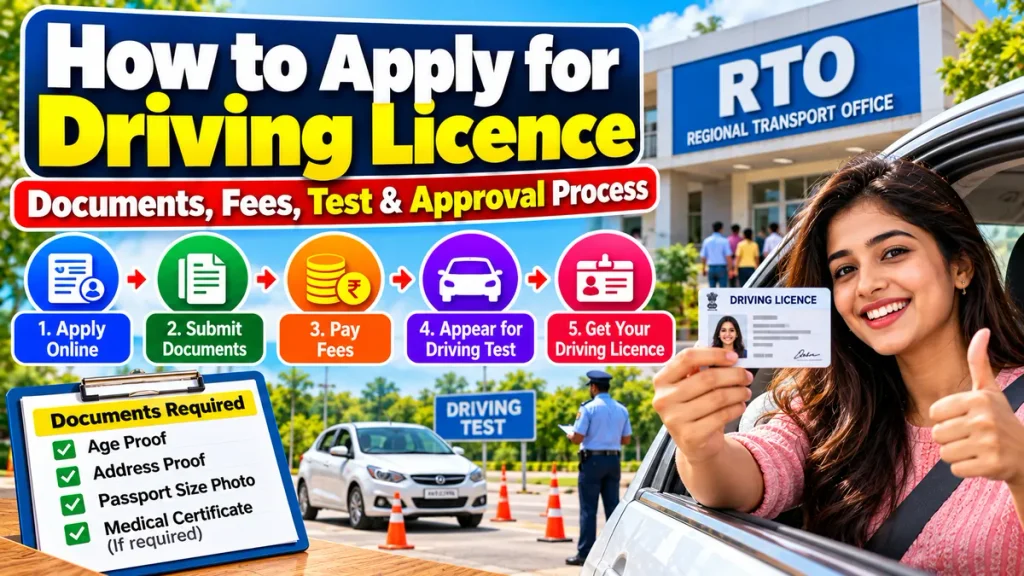
This guide explains how to apply for a Driving Licence, required documents, fees, driving-test procedure and final approval process in simple steps.
Driving Licence Application at a Glance
| Particular | Details |
|---|---|
| Application Platform | Sarathi Parivahan |
| First Step | Apply for Learner’s Licence |
| Minimum Age for LMV/MCWG | 18 years |
| Learner’s Licence Validity | 6 months |
| Permanent DL Application | After holding LL for at least 30 days |
| Learner Licence Fee | ₹150 per vehicle class |
| Learner Test Fee | ₹50 |
| Driving Test Fee | ₹300 per vehicle class |
| Driving Licence Issue Fee | ₹200 |
| Practical Test | Required for regular new DL application |
| Final Approval | After successful verification and driving test |
| Authority | State/UT Licensing Authority or RTO |
Fees listed above are the standard prescribed licensing charges. Additional state-specific or user/service charges may apply.
Who Can Apply for a Driving Licence?
Your minimum age depends on the category of vehicle you want to drive.
An applicant who is 16 years old can apply for the eligible motorcycle-without-gear category for private use, subject to applicable conditions including parental or guardian consent for a minor.
For a Light Motor Vehicle (LMV) such as a private car and the regular motorcycle-with-gear category, the applicant must generally be at least 18 years old.
For a transport vehicle licence, the normal minimum age is 20 years.
Applicants must also satisfy the required physical-fitness and documentation conditions applicable to their licence category.
Documents Required for Driving Licence Application
The exact document requirement can differ slightly between states and applicant categories, but applicants generally need proof of age and address.
The government’s Form 2 document list recognises documents such as:
- Aadhaar Card
- Passport
- Voter/electoral record
- Birth Certificate
- School Certificate
- Certain government-issued pay slips
- Life Insurance Policy
- Other documents accepted by the State Government
A self-declaration of physical fitness in Form 1 may also be required.
A Form 1A medical certificate is applicable in specified cases. Parivahan states that Form 1A is required for applicants aged 40 years or above for the relevant licensing process, and it is also required for transport-licence applicants under applicable rules.
Applicants should check their state’s Sarathi portal before uploading documents because the exact online document requirements can vary according to State Transport Department configuration.
Driving Licence Fees in India
The Central Government’s prescribed licensing-related charges include the following:
| Service | Prescribed Fee |
|---|---|
| Learner’s Licence – Each Vehicle Class | ₹150 |
| Learner’s Licence Test / Repeat Test | ₹50 |
| Driving Competence Test / Repeat Test | ₹300 per vehicle class |
| Issue of Driving Licence | ₹200 |
| Addition of Another Vehicle Class | ₹500 |
| International Driving Permit | ₹1,000 |
| Driving Licence Renewal | ₹200 |
For a typical first-time applicant applying for a single vehicle class, the statutory LL issue fee, LL test fee, driving test fee and licence issue fee together come to ₹700, before any applicable user charges or other state-specific fees.
Always check the amount calculated by the Sarathi portal before payment because the final amount shown for your application may include additional charges.
Step 1: Apply for a Learner’s Licence
A first-time applicant generally needs to obtain a Learner’s Licence before applying for the permanent Driving Licence.
Visit the official Sarathi Parivahan portal and select your State or Union Territory.
Then choose the option to apply for a New Learner’s Licence.
The general process is:
- Select your state.
- Choose New Learner’s Licence.
- Complete the application form.
- Provide personal and vehicle-class information.
- Upload documents where the online facility is enabled.
- Pay the applicable fees.
- Complete the Learner’s Licence test or appointment process applicable in your state.
Parivahan notes that the exact flow can differ from one state to another, and some applicants may need to visit the RTO on the scheduled date with original documents and their fee receipt.
Step 2: Pass the Learner’s Licence Test
Before receiving your Learner’s Licence, you may need to complete the required learner-licence test process.
The test is intended to ensure that the applicant understands basic driving and road-safety requirements before practising on public roads.
Depending on your state, the test facility may be available online or through the RTO. Parivahan specifically notes that an online Learner’s Licence test facility is available only in participating states.
Once you successfully complete the applicable process, your Learner’s Licence can be issued.
How Long Is a Learner’s Licence Valid?
A Learner’s Licence is valid for six months.
However, you do not have to wait for the entire six-month period before applying for your permanent Driving Licence.
You become eligible to apply for the new Driving Licence after holding the Learner’s Licence for at least 30 days.
Use this learning period to practise driving safely and become comfortable with traffic rules, vehicle control and road conditions.
Learner drivers must also follow the restrictions applicable to learners, including displaying the prescribed “L” markings while practising.
Step 3: Apply for the Permanent Driving Licence
Once at least 30 days have passed after your Learner’s Licence was issued, you can start the permanent DL application.
Visit the Sarathi portal again and select your state.
Go to:
Driving Licence → New Driving Licence
You will normally be asked to enter your Learner’s Licence number and date of birth.
Complete the application and proceed through the document, payment and appointment steps provided by your state.
Parivahan’s official procedure states that an application for a permanent licence is made with the valid Learner’s Licence for the same vehicle category.
Step 4: Pay the Driving Licence Fees
Complete the online payment when required.
The Sarathi payment system allows applicants to enter their application number and date of birth to calculate the applicable fee and make payment through the available payment gateway.
After payment, save or print the receipt because it may be required during your RTO visit.
Avoid making repeated payments if the first transaction appears pending. Check the payment status on the portal first.
Step 5: Book Your Driving Test Slot
For a permanent licence, the applicant normally has to appear for a test of competence to drive.
Sarathi provides online appointment or slot-booking facilities where the service has been enabled by the state.
You can generally select:
Appointments → Driving Licence Test
Then select the relevant RTO and an available date.
Not every RTO follows exactly the same digital workflow, so appointment availability and rescheduling rules may vary by state.
Step 6: Appear for the Practical Driving Test
Visit the selected RTO or authorised testing location on your appointment date.
Carry your required original documents, application details, payment receipt and any other documents mentioned in your appointment instructions.
The applicant must demonstrate the ability to safely drive the class of vehicle for which the licence is being requested.
Parivahan states that applicants should bring a vehicle of the relevant type and satisfy the competent authority that they are capable of driving it and performing the tasks specified under the Central Motor Vehicles Rules.
Depending on the vehicle category and test facility, you may be assessed on vehicle control, observation, safe manoeuvring, road discipline and other prescribed driving skills.
What Happens If You Fail the Driving Test?
Failing the first driving test does not necessarily mean that you cannot obtain a licence.
You can generally apply for a repeat test according to the applicable rules and state procedures.
The prescribed fee for a driving competence test or repeat test is ₹300 for each vehicle class.
Use the additional time to practise the areas where you had difficulty before appearing again.
Driving Licence Approval Process
If you pass the driving test and your application and documents are found in order, the licensing authority can approve your Driving Licence.
Parivahan states that a candidate who successfully passes the competence test will be issued the Driving Licence and it may be sent to the address provided through Speed Post.
The actual processing and delivery time can vary by RTO and state.
You can check the latest status through the Sarathi portal using your application details.
Common Reasons for Driving Licence Application Problems
Applications may be delayed if information is incomplete or inconsistent.
Common problems can include:
- Incorrect name or date of birth
- Incorrect address information
- Missing documents
- Wrong vehicle category
- Failed document verification
- Payment remaining incomplete
- Missing the scheduled test appointment
- Failing the practical driving test
Always review your application carefully before final submission.
Frequently Asked Questions
1. Can I apply for a Driving Licence online?
Yes. You can begin the application process through the official Sarathi Parivahan portal. Certain verification and driving-test steps may still require an RTO visit.
2. Can I get a Driving Licence without a Learner’s Licence?
For a regular first-time Driving Licence application, you generally need a valid Learner’s Licence for the relevant class of vehicle before taking the permanent licence test.
3. How long must I wait after getting my Learner’s Licence?
You can apply for the permanent Driving Licence after holding the Learner’s Licence for at least 30 days.
4. How long is a Learner’s Licence valid?
A Learner’s Licence is generally valid for six months.
5. What is the fee for a new Driving Licence?
The prescribed fee includes ₹300 for the driving competence test per vehicle class and ₹200 for issuing the Driving Licence. Learner’s Licence and learner-test charges apply separately. Additional user or state charges may also apply.
6. Is a driving test compulsory?
For the standard new permanent Driving Licence process, the applicant is required to demonstrate competence to drive before the licensing authority.
7. What is the minimum age for a car Driving Licence?
For a private Light Motor Vehicle such as a car, the normal minimum age is 18 years.
8. What happens after I pass the driving test?
After successful testing and completion of the required verification, the licensing authority can issue your Driving Licence. Parivahan states that successful candidates’ licences may be sent to the provided address through Speed Post.
Conclusion
Applying for a Driving Licence in India has become more convenient because much of the process can be initiated online through the Sarathi Parivahan portal.
A first-time applicant generally starts by obtaining a Learner’s Licence, completes the required learner test and practises driving. After holding the Learner’s Licence for at least 30 days, the applicant can apply for the permanent licence, pay the prescribed fees, book the driving-test slot and appear for the practical test.
Before applying, keep your age and address proof, Learner’s Licence, physical-fitness documents and other required records ready. Make sure all information is accurate and select the correct vehicle category.
Passing the practical driving test is one of the most important stages. Once the test and document verification are successfully completed, your application can be approved and the Driving Licence issued.
For the smoothest experience, use only the official Sarathi Parivahan service, check your state’s specific requirements and carefully verify every detail before submitting your application.