Electrician Course Application: Required Documents and Eligibility Criteria
For students and job seekers who are interested in developing hands-on technical skills in electrical wiring, installation, maintenance, testing, and safety, an electrician course can be a beneficial choice. To enrol in a course, it is important to understand the Electrician Course Application process, required documents, and eligibility criteria.
The requirements may differ depending on the training institute, course type, qualification level, and whether the course is offered online or offline. Some electrician courses are suitable for beginners, while others may have prerequisites or require technical experience.
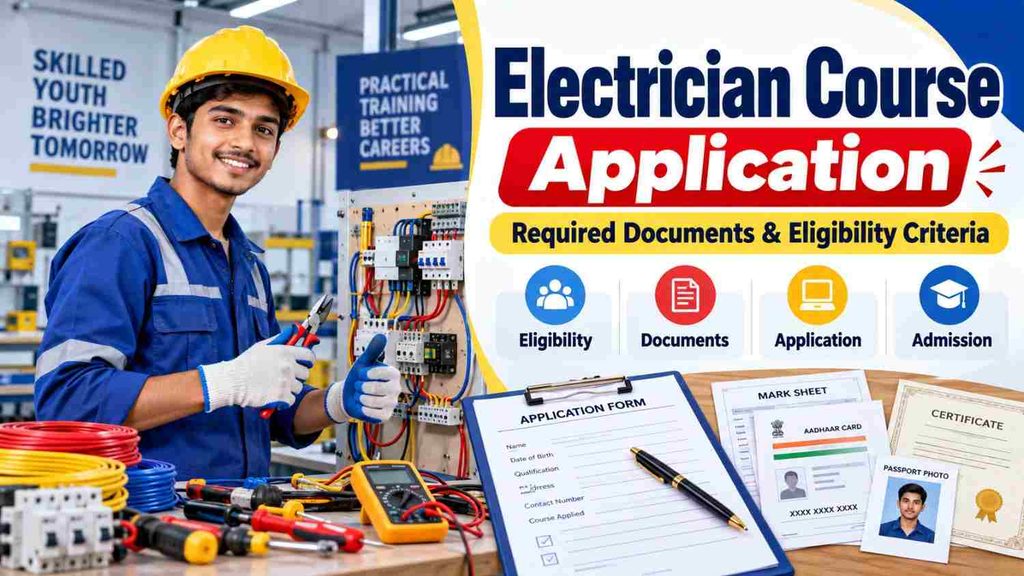
Candidates should read the admission conditions of their training provider before filling out the application for
Electrician Course Application – Quick Overview
| Particular | Details |
|---|---|
| Course Name | Electrician / Electrical Training Course |
| Eligibility | Depends on course and institute |
| Common Qualification | 10th or 12th Pass |
| Learning Mode | Online, Offline, or Practical Training |
| Application Mode | Online or Offline |
| Main Documents | ID Proof, Education Certificates, Photos, Application Form |
| Practical Training | May be included |
| Course Fees | Institute and programme specific |
| Certificate | Available in selected courses |
| Course Duration | Depends on programme |
| Career Scope | Wiring, Maintenance, Installation, Repair, and Technical Work |
What Is an Electrician Course?
An electrician course is a technical training programme that teaches learners the basics of electrical systems and how to handle wiring, testing, installation, maintenance, and electrical safety.
Students may learn:
- Basic electricity
- Voltage and current
- Resistance
- Electrical circuits
- AC and DC systems
- House wiring
- Switches and sockets
- Circuit breakers
- Earthing
- Electrical tools
- Testing equipment
- Fault identification
- Electrical safety
- Basic maintenance
Some programmes focus mainly on theory, while others provide both theoretical and practical training.
Who Can Apply for an Electrician Course?
Eligibility depends on the type of electrician course and the rules of the training institute.
Some beginner-level courses may be suitable for:
- 8th pass candidates
- 10th pass candidates
- 12th pass candidates
- ITI aspirants
- Job seekers
- Electrician helpers
- Maintenance workers
- Technicians
- Apprentices
- Beginners interested in electrical work
Additional qualifications, practical experience, or technical education may be required for professional or advanced programmes.
Eligibility Criteria for Electrician Course
Eligibility criteria may vary from course to course. Some common requirements include:
Educational Qualification
Several electrician courses accept students who have passed Class 10 or Class 12.
Some basic skill courses may have lower educational requirements, while advanced technical courses may require ITI, Diploma, or other recognised technical qualifications.
Age Requirement
Some training programmes may have a minimum age requirement.
Applicants should carefully check the age conditions specified by the training provider before applying.
Basic Academic Skills
Students may need basic knowledge of:
- Mathematics
- Reading
- Measurements
- Basic science concepts
These skills can help learners understand technical instructions and electrical calculations.
Interest in Technical Work
Electrician training involves practical work, tools, wiring, testing, and maintenance. Students should be comfortable learning technical and hands-on skills.
Physical Ability
Some practical electrical training may require learners to stand for extended periods, operate tools and equipment, work in different positions, and perform installation-related tasks.
Eligibility for 10th Pass Students
Students who have completed Class 10 can explore various electrician courses.
10th pass students may consider:
- Electrician training courses
- ITI Electrician programmes
- Wiring courses
- Electrical maintenance programmes
- Skill development courses
- Vocational electrical training
- Apprenticeship-related programmes
Final eligibility depends on the institute and course.
Eligibility for 12th Pass Students
12th pass candidates can also apply for different electrician and electrical training programmes.
They may explore:
- Basic electrician training
- Advanced electrical courses
- Electrical maintenance courses
- Technical certification programmes
- Vocational training
- Apprenticeship opportunities
- Skill development programmes
Some electrical subjects may be easier for students with science or technical backgrounds, while many beginner electrical programmes accept students from different educational backgrounds.
Documents Required for Electrician Course Application
Applicants should ensure that all required documents are ready before filling out the application form.
Commonly required documents may include:
- Aadhaar card or other valid identity proof
- 10th mark sheet
- 10th pass certificate
- 12th mark sheet, if applicable
- 12th pass certificate, if applicable
- Date of birth proof
- Address proof
- Passport-size photographs
- Signature
- Mobile number
- Email address
- Category certificate, if applicable
- Previous technical training certificate, if applicable
- Application form
- Fee payment receipt, if applicable
The exact list of documents may differ from one training institute to another.
Why Are Educational Documents Required?
Educational certificates and mark sheets help the institute verify whether applicants meet the minimum qualification criteria.
If a course requires a 10th pass qualification, applicants may need to provide:
- Class 10 mark sheet
- Class 10 pass certificate
Similarly, if a programme requires a 12th pass qualification, applicants may need to provide Class 12 documents.
Identity and Address Proof
Training institutes may ask for identification and address details during admission.
Common documents may include:
- Aadhaar card
- Voter ID
- Driving licence
- Passport
- Other accepted government-issued ID
Applicants should provide valid and clear documents.
How to Apply for an Electrician Course
The application process may vary depending on the institute, but most courses follow a similar procedure.
Step 1: Select the Electrician Course
Choose a course based on your qualification and career goals.
Check whether the course covers:
- Basic electrical work
- Wiring
- Maintenance
- Installation
- Industrial electrical work
- Technical skill development
Step 2: Check Eligibility
Carefully review the eligibility requirements.
Check whether the programme accepts:
- 8th pass candidates
- 10th pass candidates
- 12th pass candidates
- ITI students
- Other technical qualifications
Step 3: Review Course Details
Before applying, check:
- Course duration
- Course syllabus
- Training mode
- Practical training
- Certificate availability
- Fees
- Assessment process
Step 4: Complete the Application Form
Applicants may need to provide:
- Full name
- Date of birth
- Address
- Educational qualification
- Mobile number
- Email address
- Category details, if applicable
All information should match the submitted documents.
Step 5: Upload or Submit Documents
Upload clear scanned copies for online applications or submit photocopies for offline applications.
Step 6: Pay the Application or Course Fee
Some electrician courses may be available free of charge, while others may require payment such as:
- Application fee
- Admission fee
- Training fee
- Examination fee
- Certificate fee
Students should review the complete fee details before making any payment.
Step 7: Complete Verification
The institute may verify educational and identity documents before granting admission.
Step 8: Receive Admission Confirmation
Eligible applicants may receive admission confirmation after successful verification and fee payment.
Online vs Offline Electrician Course Application
| Online Application | Offline Application |
|---|---|
| Apply through website or online portal | Apply at institute or training centre |
| Upload digital copies of documents | Submit physical copies of documents |
| Online fee payment may be available | Cash or other payment options may be available |
| Convenient from home | Direct assistance may be available |
| Digital confirmation | Physical or written confirmation may be provided |
The application method varies from institute to institute.
Electrician Course Fees
Different courses may charge different amounts.
The total cost can vary according to:
- Training institute
- Course duration
- Practical facilities
- Certification
- Course level
- Online or offline mode
- Government or private institution
Some electrician courses online may be available free of charge. Practical or professional training programmes may involve fees.
Applicants should review all charges before completing admission.
Course Duration
The duration of electrician courses depends on the programme.
Basic online programmes may take:
- A few hours
- Several days
- A few weeks
Practical or vocational programmes may continue for:
- Several months
- One year
- Longer, depending on the training programme
Applicants should check the official course duration before applying.
Is Practical Training Important?
Yes. Practical training is important because electrical work involves real wiring systems, testing devices, tools, and safety risks.
Practical training can help learners understand:
- Wire connections
- Switch installation
- Socket wiring
- Testing methods
- Fault detection
- Use of electrical tools
- Safety procedures
Electrical tasks should only be performed with proper training and supervision.
What Skills Can Students Learn?
Students may develop skills in:
- Basic electrical concepts
- House wiring
- Circuit connections
- Electrical safety
- Tool handling
- Voltage testing
- Continuity testing
- Fault identification
- Maintenance
- Installation
The syllabus varies depending on the course.
Career Opportunities After Electrician Course
After completing suitable training and gaining experience, candidates may explore positions such as:
- Electrician Helper
- Domestic Electrician
- Wiring Technician
- Electrical Technician
- Maintenance Technician
- Building Maintenance Worker
- Industrial Electrical Assistant
- Electrical Service Technician
- Solar Installation Assistant
- Electrical Maintenance Assistant
Job opportunities depend on qualifications, skills, experience, employer requirements, and local licensing rules.
Important Things to Check Before Applying
Before applying for an electrician course, check:
- Course eligibility
- Minimum qualification
- Age requirements
- Required documents
- Course syllabus
- Practical training availability
- Course duration
- Fee structure
- Certificate conditions
- Training institute details
- Assessment requirements
- Recognition of the course
Applicants should not choose a course only because it offers a certificate or promises a guaranteed job.
Frequently Asked Questions
What is the eligibility for an electrician course?
Eligibility depends on the course and institute. Many beginner courses accept 10th or 12th pass students, while advanced programmes may have additional technical requirements.
Can a 10th pass student apply for an electrician course?
Yes. Several electrician, ITI, vocational, and skill development programmes are available for eligible 10th pass students.
Can a 12th pass student apply for electrician training?
Yes. Depending on the eligibility criteria, 12th pass students may apply for basic and advanced electrical training courses.
What documents are required for electrician course admission?
Common documents include educational certificates, mark sheets, identity proof, address proof, photographs, signature, application form, and fee receipt, if applicable.
Is Aadhaar card required for an electrician course?
Many institutes may accept Aadhaar as identity proof. However, the exact documents accepted depend on the training provider.
Can I apply for an electrician course online?
Some institutes provide online application forms, while others may require offline applications or document submission.
Is there any age limit for electrician courses?
Some programmes may have minimum or maximum age requirements. Applicants should check the official eligibility rules of the particular course.
How much does an electrician course cost?
Fees vary depending on the course type, institute, duration, practical facilities, and certification. Some online programmes may also be free.
Is practical training compulsory?
Practical training is important for developing real electrical skills. The exact practical requirement depends on the programme.
Can I get a job after completing an electrician course?
Completing a course can improve job readiness, but employment depends on hands-on skills, qualifications, experience, employer requirements, and applicable licensing conditions.
Conclusion
The Electrician Course Application process generally involves checking eligibility, preparing educational and identity documents, choosing an appropriate training programme, completing the application form, and fulfilling the admission requirements.
Depending on the programme, 10th and 12th pass students can explore different electrician and electrical training options. Students should carefully review the course syllabus, duration, practical training, fees, certification, and required documents before applying.
Theoretical learning, practical training, electrical safety knowledge, and certification can help learners develop useful technical skills and prepare for opportunities in electrical installation, wiring, maintenance, repair, and other technical occupations.